

Monarch butterflies migrate alone during the day. They come down at night and gather in clusters, called roosts.
Some roosts have only a handful of butterflies, while others will have hundreds or even thousands. Some last for only a night or two, while some trees will be filled with monarchs for a week or longer, and some areas will be used year after year as monarchs make their annual southbound migration.
Those who know where to find monarch roosts may have an annual opportunity to see them, but for others, seeing monarchs flowing into a tree or group of trees is a rare sight. Wrote one Journey North observer: "The air resembled a monarch airport, with monarchs coming in from every direction, floating through the air, checking out various trees, landing, then taking off again. When one butterfly approached a cluster, the roosting butterflies flashed their wings. It took from about 7:15 to 7:35 p.m. for them to cluster in the trees, just before dark."
Having trees that provide some shelter from the wind as well as nearby nectar sources may be two important considerations as monarchs choose roost sites.
One hypothesis for why monarchs roost is that it's an anti-predator strategy. Cool temperatures paralyze monarchs, making them vulnerable to predators, so a roost could provide some safety in numbers.
Journey North has been tracking roosting behavior using the reports of community scientists like you for nearly three decades. As roost reports move south, the fall roost map reveals the progress of the monarch migration.
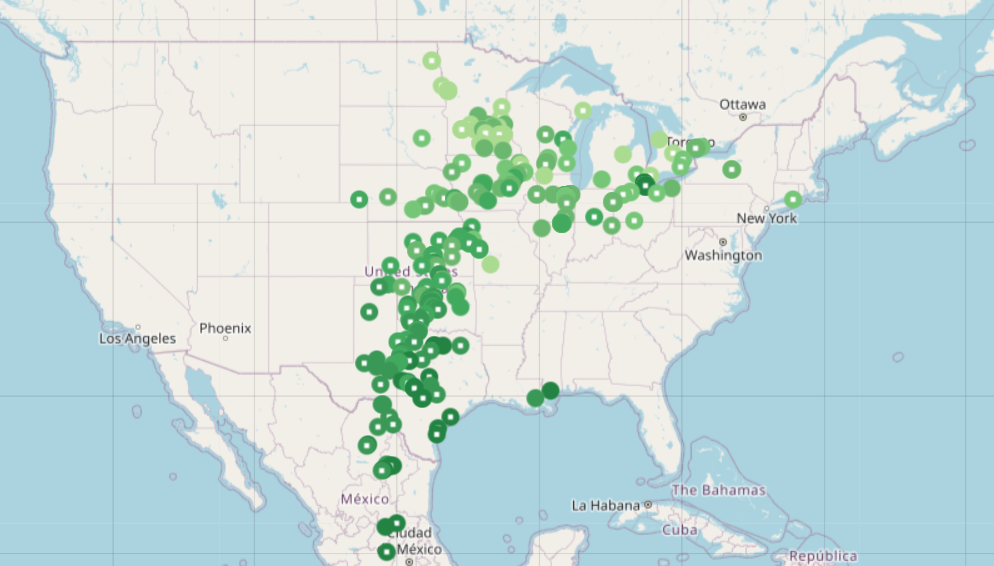
If you see a monarch roost, whether it's five monarchs or 5,000, report it to Journey North! If you want to see one, consider looking for them in spots where people have reported them in past years. For example, Point Pelee National Park in Ontario is a known roosting spot, as it provides the southernmost point of land before monarchs are forced to cross Lake Erie. Others are less obvious, but may form multiple years in a row or multiple times during the same season.
Take a look at the Journey North maps to see where roosts have been reported near you over the years.
Top image: Tracy in Corpus Christi, Texas